

CASTL Leads Global Discussion on Future-Ready Biomanufacturing Workforce Solutions at BIO2026
Charlottetown, PEI – June 19, 2026 - An international panel of leaders from Canada, Ireland, the United States and South Korea will convene at the BIO International Convention 2026 (BIO2026) to discuss how global collaboration can help address one of the life sciences sector’s most urgent challenges: building the skilled biomanufacturing workforce needed to support continued growth, innovation and patient access.
BIO2026, taking place June 22-25, 2026, in San Diego, California, is the world’s largest global event for biotechnology and life sciences. The convention brings together the full biotechnology ecosystem, including industry leaders, emerging companies, researchers, investors, academic institutions, non-profits and government representatives, for four days of partnering, programming, company presentations, networking and discussion on the issues shaping the future of the sector.
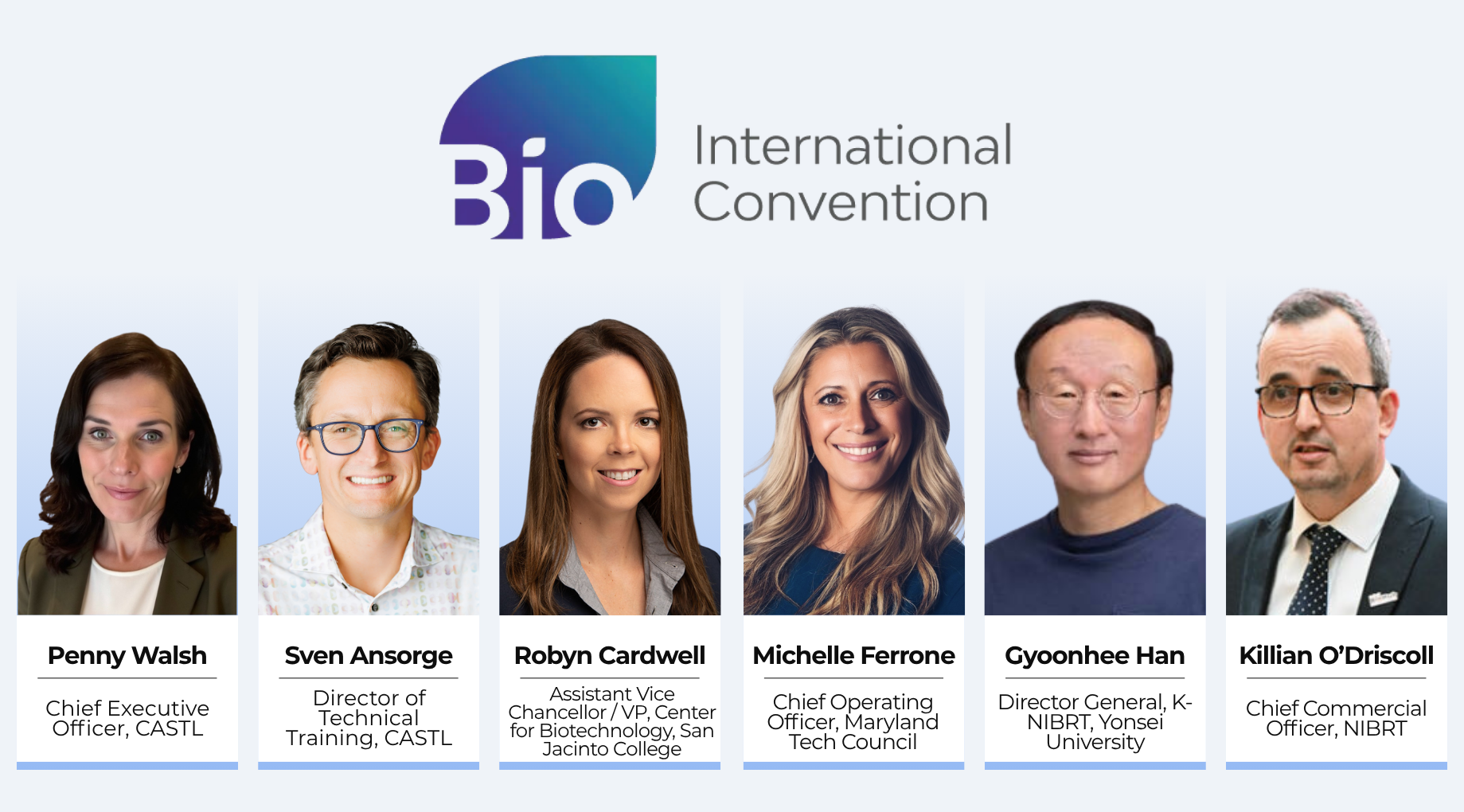
The panel, “Future-Ready Solutions to the Global Biomanufacturing Talent Challenge,” will take place on Wednesday, June 24, 2026, from 11:00 a.m. to 12:00 p.m. PDT. Moderated by Penny Walsh, Chief Executive Officer of the Canadian Alliance for Skills and Training in Life Sciences (CASTL), the session will bring together perspectives from organizations working in different regional contexts but facing a shared challenge: how to prepare, upskill and retain talent for an increasingly complex biomanufacturing landscape.
The conversation is rooted in a broader international effort to strengthen workforce development through the National Institute for Bioprocessing Research and Training (NIBRT) Global Partner Programme. Through this programme, qualified training and education organizations license NIBRT’s expertise and curriculum while receiving support in areas such as facility design, equipment planning, operating models, curriculum delivery and train-the-trainer development. This shared framework enables partners to adapt proven biopharma training approaches to local industry needs while contributing to a global exchange of knowledge, best practices and capacity-building models.
For the participating organizations, BIO2026 offers an important opportunity to bring that international collaboration into a sector-wide discussion. As countries and regions invest in life sciences growth, advanced therapies, vaccine manufacturing and resilient supply chains, workforce readiness has become a common priority. The panel will explore how partners across industry, academia, training organizations and government can work together to align training with evolving demand, expand access to practical skills development and build more resilient talent pipelines.
Panelists will discuss the main drivers of workforce pressures, including whether current challenges are best understood as a skills shortage, a pipeline issue or a mismatch between training and industry needs. The conversation will also explore the impact of economic conditions, the future skills required for biomanufacturing, and the role of disruptive forces such as artificial intelligence, automation and Industry 5.0 in reshaping workforce requirements.
The panel will feature:
• Killian O’Driscoll, MSc, Chief Commercial Officer, National Institute for Bioprocessing Research and Training (NIBRT)
• Michelle Ferrone, Chief Operating Officer, Maryland Tech Council
• Sven Ansorge, PhD, Director of Technical Training and Site Lead, Canadian Alliance for Skills and Training in Life Sciences (CASTL)
• Gyoonhee Han, PhD, FRSC, Director General, Korea National Institute of Bioprocess Research and Training (K-NIBRT, MoHW-MoCIT), Yonsei University
• Robyn Cardwell, PhD, Assistant Vice Chancellor / Vice President, Center for Biotechnology at San Jacinto College
By bringing together representatives connected to workforce development initiatives across multiple regions, the session will move beyond any single national perspective. It will examine how shared curricula, hands-on training environments, trainer development, industry input and regional adaptation can work together to support workforce readiness in a sector where technologies, regulations and production models continue to evolve.
Attendees will leave with practical insights into how collaborative workforce development models can help bridge skills gaps, align training with industry demand and prepare the next generation of talent for a rapidly evolving biomanufacturing landscape.
Quotes
“Biomanufacturing is a global sector, and the workforce solutions that support it must be informed by global collaboration. This panel brings together leaders who are developing practical approaches in their own regions and sharing lessons across borders. The discussion will focus on what we can learn from one another and how coordinated training models can help prepare talent for the needs of today and tomorrow.”
—Penny Walsh, CEO, Canadian Alliance for Skills and Training in Life Sciences (CASTL)
‘’Workforce development is one of the most important challenges facing biomanufacturing right now, and it is not a challenge any one country or organisation can solve alone. NIBRT has spent years building training infrastructure, a curriculum and robust delivery mechanism that work together in real industry environments, and through our Global Partner Programme we are seeing what becomes possible when organisations share that knowledge across borders. This panel brings together people who are doing the hard work of building talent pipelines in their own regions, and I am looking forward to a conversation about what we can all learn from each other.’’
—Killian O’Driscoll, MSc, Chief Commercial Officer, National Institute for Bioprocessing Research and Training (NIBRT)
“BioHub Maryland’s success is proof that global collaboration can translate directly into local workforce impact. At BioHub Maryland, powered by Maryland Tech Council, we are adapting NIBRT’s globally recognized biomanufacturing training curriculum and utilizing best practices from its Global Partner Program to prepare more Marylanders for skilled careers and give employers confidence in the local talent pipeline. I look forward to discussing how insights shared across borders can build a resilient and competitive biopharma industry in Maryland and beyond.”
—Michelle Ferrone, Chief Operating Officer, Maryland Tech Council
“The demand for the workforce in Korea's bio-industry has been increasing rapidly recently. To meet this demand, the Korean government has been operating the K-NIBRT program since 2021, which adapts Ireland's NIBRT curriculum for the Korean market. The K-NIBRT Training Centre educates and supplies the necessary talent in various fields, such as antibodies, vaccines, and gene and cell therapies, and quality control and quality assurance. Through the NIBRT Global Partner Program, we will share know-how that addresses diverse educational needs and, by providing globally standardized educational courses, ensure an adequate supply of the talent required by the Korean bio-industry.”
— Gyoonhee (Kenny) Han, Director General, Korean National Institute for Bioprocessing Research and Training (K-NIBRT)
"San Jacinto College's partnership with NIBRT demonstrates how community colleges can deliver scalable biomanufacturing talent pipelines by adapting proven global approaches to meet regional needs. Our GMP-simulated Center for Biotechnology and stackable credentials are opening doors for a variety of students and directly connecting them to employers in Houston’s expanding life sciences sector. I look forward to sharing how this accessible, regional model strengthens the global effort to prepare a workforce ready for today’s and tomorrow’s innovations.”
—Robyn Cardwell, PhD, Assistant Vice Chancellor / Vice President (AVC/VP), Center for Biotechnology – Biomanufacturing, San Jacinto College
About CASTL
The Canadian Alliance for Skills and Training in Life Sciences (CASTL) is Canada’s biomanufacturing training partner, dedicated to developing skilled talent to drive the country’s thriving biomanufacturing sector. With state-of-the-art, GMP-simulated facilities from coast to coast (in Charlottetown, PE; Montreal QC, and Vancouver, BC), CASTL delivers hands-on, industry-informed training alongside flexible online learning. As Canada’s exclusive provider of National Institute for Bioprocessing Research and Training (NIBRT) programs, CASTL offers world-class education with support from adMare BioInnovations and its adMare Academy, shaping the next generation of life sciences professionals. For more information, visit castlcanada.ca
About the NIBRT Global Partner Programme
The NIBRT Global Partner Programme supports an international alliance of training and education organisations working to address the global shortage of skilled biopharma talent. Through the programme, qualified organisations license NIBRT's curriculum and expertise to deliver industry-recognised biopharma training in their region, adapting proven training models to local industry needs. For more information, visit nibrt.ie.
Media Contact
Heidi Reinblatt
Director, Marketing and Communications
Canadian Alliance for Skills and Training in Life Sciences
Heidi@castlcanada.ca
-30-