

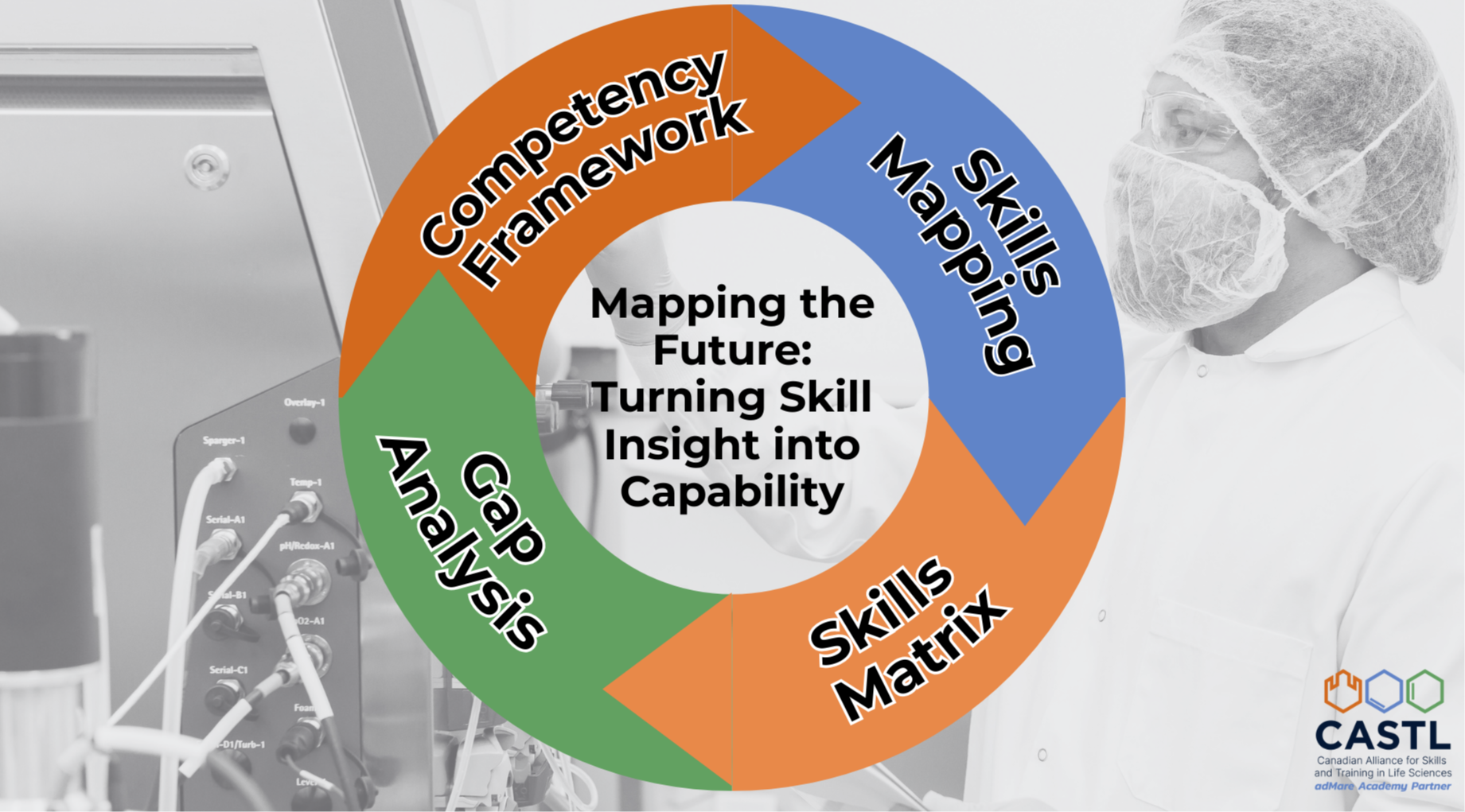
Mapping the Future: Turning Skill Insight into Capability
Across biomanufacturing and beyond, one theme keeps coming up: talent.
Not just finding it but understanding it.
Whether it’s cell and gene therapy outpacing commercial readiness, cleantech scaling faster than policy can adapt, or medtech racing ahead of regulatory clarity, every sector is quietly asking the same question:
Do we have the skills we need for what’s coming next?
Most organizations can list their roles. Far fewer can articulate the full scope of skills those roles rely on. And when you can’t see capability clearly, you can’t build it intentionally. That’s where things start to slip.
Why Skills Mapping Is Becoming a Strategic Imperative
In fast-moving, highly regulated environments, intuition isn’t enough.
Workforce planning now relies on visibility — understanding what people can do today, what they’ll need tomorrow, and where strategic investment will actually matter.
Skills mapping brings that clarity.
- Skills matrices reveal team-level strengths, vulnerabilities, and readiness.
- Competency frameworks define how knowledge, behaviours, and technical ability combine to create consistent performance.
Together, they form a living map of capability, one that evolves as technology, regulation, and strategy shift.
This isn’t a HR project.
It’s operational risk management.
It’s business continuity.
It’s how leaders prepare their organizations for what’s coming instead of reacting to what’s already arrived.
Why Capability Matters Even More in the Age of AI
There’s another force accelerating this shift — one reshaping work across every sector: AI.
Automation is evolving daily. Digital tools are changing how tasks get done. Entire workflows are being redesigned faster than training teams can update their slide decks.
A once-a-year training cycle won’t prepare a workforce that needs to adapt weekly.
A static curriculum can’t support tools that didn’t exist when the course was created.
In this landscape, capability becomes the real competitive advantage:
- It's transferable — it holds up even when the task changes.
- It’s durable — it adapts alongside emerging technologies.
- It’s proactive — designed for the future, not built from the past.
Organizations that focus on capability will thrive in the AI era.
Those that cling to traditional L&D models will fall behind — not because their people aren’t capable, but because the system built to support them isn’t.
The Power of Simulation in Closing the Gap
Once gaps are visible, the next challenge is closing them — safely, efficiently, and without slowing down production.
Simulation-based learning is becoming a differentiator of this shift.
It creates a protected space where people can practise, make mistakes, and build fluency before stepping into high-stakes environments. Across industries, you’ll see simulation used to:
- Rehearse aseptic technique and gowning
- Build comfort with cleanroom flow and equipment
- Prototype new processes without disrupting operations
- Accelerate onboarding in regulated environments
- Reduce errors by strengthening applied skill and confidence
From life sciences to advanced manufacturing to emerging tech, teams are using simulated and experiential environments to strengthen skill development. The tools vary — physical labs, digital twins, pilot systems — but the purpose is consistent: helping people build real competence before the stakes are real.
Different tools.
Same intention.
Give people space to practise, and capability grows exponentially.
From Insight to Momentum
When organizations pair clear skills visibility with meaningful opportunities to practise those skills, they move from reactive to proactive.
Employees don’t just learn what to do — they understand why it matters.
Training stops being an event and becomes part of how work gets done.
Capability starts compounding.
And that’s where partners like CASTL step in: helping organizations turn insight into action through capability mapping, competency frameworks, and simulation-based learning that reflects real operational pressure — not just classroom theory.
But the real message is this:
The future moves fast.
Success will belong to the teams who can see what’s coming — and build the capability to meet it long before it arrives.